
Closed-Cycle Cryostat for Optical Measurements |
||||||||||||||||||||||||||
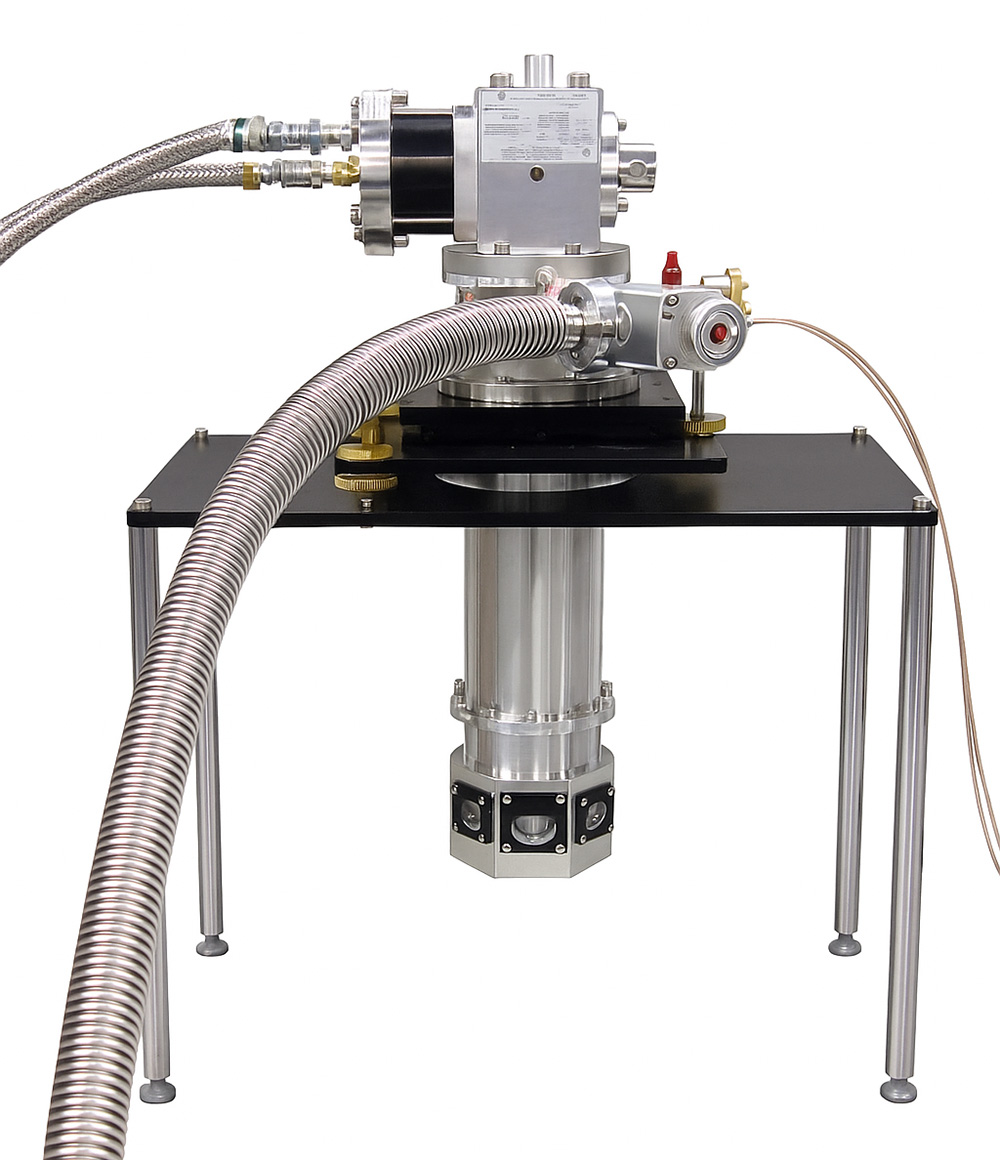 |
||||||||||||||||||||||||||
| This closed-cycle helium cryostat uses a Gifford-McMahon (GM) cryocooler. A compressor circulates helium gas in a closed loop, achieving temperatures of 4 K or below in approximately 2–3 hours without liquid cryogens such as liquid helium. A vacuum shroud with synthetic fused silica windows and a radiation shield support optical experiments such as transmission and photoluminescence (PL) measurements. The standard support stand includes sample angle adjustment and XYZ positioning mechanisms for flexible optical alignment. A temperature controller provides stable temperature control from 4 K to room temperature. The detachable tail section allows easy sample replacement by venting the sample vacuum space at room temperature. The air-cooled compressor operates on a 100 V AC power supply and requires no special installation work, making this cryostat a convenient platform for optical measurements. | ||||||||||||||||||||||||||
■ Specifications |
||||||||||||||||||||||||||
|
||||||||||||||||||||||||||
*Specifications and appearance are subject to change without notice for product improvement. |
||||||||||||||||||||||||||
■ Cryostat Overview and Applications in Optical Measurements |
||||||||||||||||||||||||||
|
A cryostat is a system used to cool a sample to cryogenic temperatures and maintain it at those temperatures for optical measurements and material characterization. This product employs a closed-cycle system that requires no liquid cryogens. Helium gas is circulated through a cryocooler to achieve temperatures of 4 K or below in approximately 150 minutes. A vacuum chamber and radiation shield minimize heat input, while a temperature sensor and heater enable precise temperature control with a stability of ±0.1 K. For optical measurements, synthetic fused silica windows on multiple sides accommodate a wide range of configurations, including laser excitation, emission observation, and transmission and reflection measurements. Representative applications are described below. |
||||||||||||||||||||||||||
|
● Photoluminescence (PL) Measurements: A low-temperature environment that suppresses thermal excitation is essential for precise evaluation of excitons, defect levels, and bandgap properties in materials. Measurements near 4 K enable high-resolution emission spectroscopy and the observation of fine spectral structures, making them useful for evaluating the quality of semiconductors, quantum dots, and two-dimensional materials. |
||||||||||||||||||||||||||
|
● Electroluminescence (EL) Measurements: When evaluating light-emitting devices such as LEDs and laser diodes under current injection, low-temperature measurements help clarify recombination processes and reveal the effects of suppressing nonradiative losses. Examining the temperature dependence of emission efficiency and spectral purity enables assessment of device performance limits. |
||||||||||||||||||||||||||
|
● Photodetector Characterization: Photodetectors such as photodiodes and infrared sensors exhibit significantly reduced dark current at low temperatures, allowing accurate evaluation of their intrinsic sensitivity and noise characteristics. Analysis of quantum efficiency, response speed, and temperature dependence supports the design of high-performance detectors and their use in advanced fields such as astronomical observation and quantum communications. |
||||||||||||||||||||||||||
| This product serves as a reliable cooling platform for stable, reproducible low-temperature optical measurements in a wide range of applications, including materials development, fundamental research, and product evaluation. | ||||||||||||||||||||||||||
■ What Is Internal Quantum Efficiency (IQE)? |
||||||||||||||||||||||||||
|
Internal quantum efficiency (IQE) is a measure of the fraction of carriers (electrons and holes) generated in a semiconductor that recombine radiatively, emitting light.
Definition: IQE is an important indicator for evaluating the effects of nonradiative recombination in materials and structures. |
||||||||||||||||||||||||||
■ Evaluating Relative Internal Quantum Efficiency (IQE) Using Low-Temperature PL Measurements |
||||||||||||||||||||||||||
|
In this method, the PL intensity at low temperature (typically around 10 K) is taken as the maximum emission due to radiative recombination. Relative internal quantum efficiency (IQE) is then calculated by comparing it with the PL intensity at room temperature (300 K).
Assumptions:
Approximate formula for relative IQE: |
||||||||||||||||||||||||||
■ Steps for Calculating Internal Quantum Efficiency (IQE) Using Low-Temperature PL Measurements |
||||||||||||||||||||||||||
|
||||||||||||||||||||||||||
■ What Is External Quantum Efficiency (EQE)? |
||||||||||||||||||||||||||
|
External quantum efficiency (EQE) is defined as the ratio of the number of photons emitted outside a semiconductor device (such as an LED or solar cell) to the number of injected or generated carriers (electrons).
Definition: EQE represents the device's actual light-emission efficiency. Measurement methods include absolute PL measurements using an integrating sphere and measurements under electrical drive. |
||||||||||||||||||||||||||
■ Measuring External Quantum Efficiency (EQE) Using an Integrating Sphere (2π Measurement) |
||||||||||||||||||||||||||
|
External quantum efficiency (EQE) can be calculated by measuring the light emitted by a device (spectral radiant flux) with an integrating sphere and comparing the emitted photon rate with the injected electron rate. The following method uses radiant flux measured over the forward hemisphere (2π solid angle).
|
||||||||||||||||||||||||||
■ Relationship Between External Quantum Efficiency (EQE) and Internal Quantum Efficiency (IQE) |
||||||||||||||||||||||||||
|
EQE and IQE are related by the following equation:
where: Light extraction efficiency is affected by total internal reflection caused by refractive index differences, device structures such as reflective layers and surface patterns, and optical absorption. IQE describes the light-emission efficiency within the material, while EQE describes the efficiency of light actually escaping from the device. IQE can reach a maximum of 100%, whereas EQE is typically lower. |
